
Machine learning vs. Deep Learning: A 2026 Strategic Guide for Choosing the Right Model
VMachine Learning vs Deep Learning: Learn key differences, use cases, tools & career paths with hands-on AI training in Vadodara.
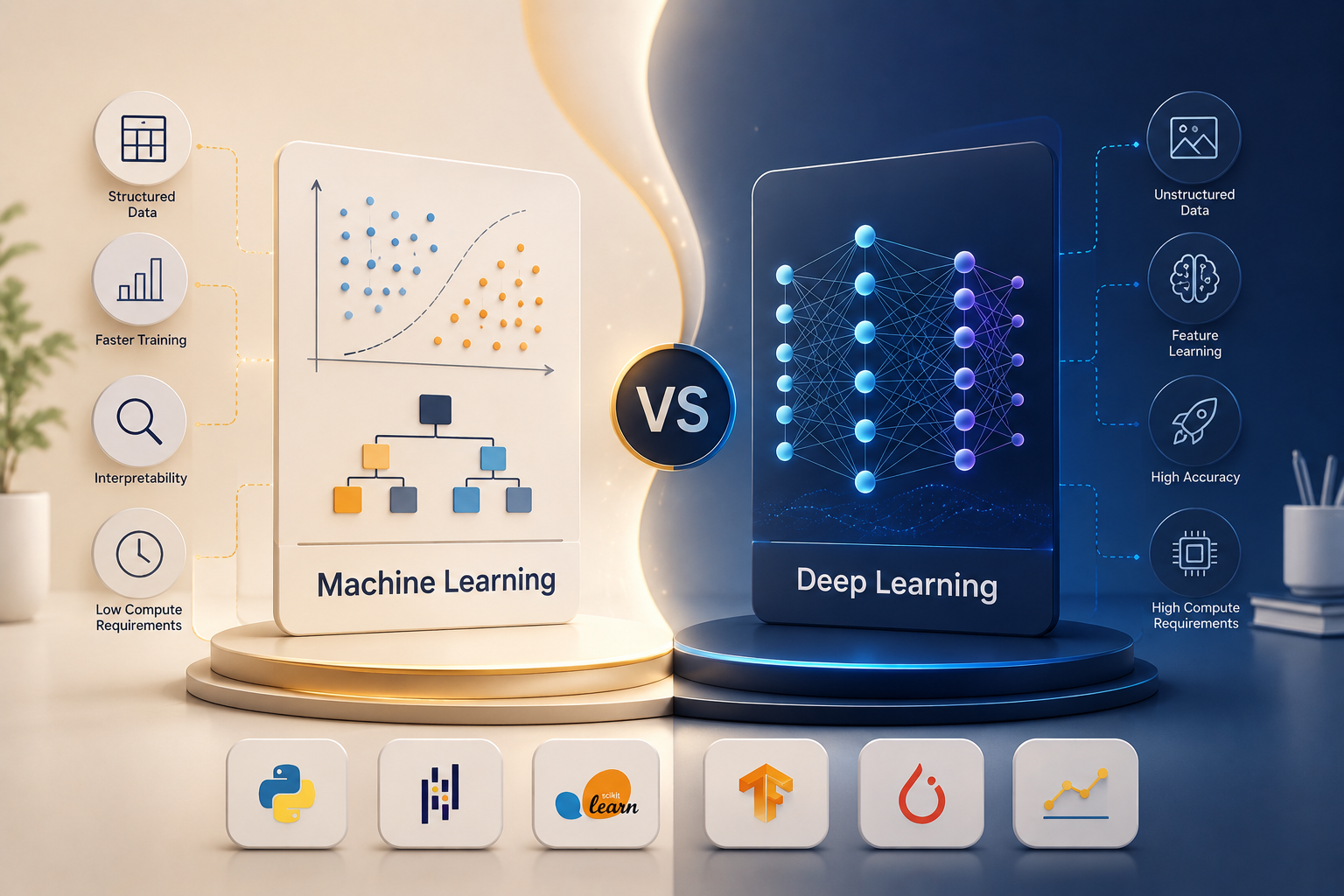
The AI space has generated a lot of jargon to be used interchangeably where it doesn't belong. Machine learning and deep learning are related but distinct disciplines, and choosing the right one for a given problem makes the difference between an efficient solution and an overcomplicated one. If you are a professional, then a course in machine learning course for beginners is ideal for you as it is structured in a way that provides a beginner's perspective and clarity before you start jumping into either field.
The Core Difference Nobody Explains Clearly
Machine learning is an AI area in which systems learn patterns from data and get better at their tasks over time without being specifically programmed for each situation. Learning is done by recognizing patterns of input variables and output variables.
Deep learning sits inside machine learning as a further subset. It is based on artificial neural networks with multiple layers (deep), which process the data at successive stages of abstraction. While a machine learning model needs to use features defined by humans to work on a data set, a deep learning model uses its own neural network to learn the features from the raw data.
Where Machine Learning Shines?
In reality, machine learning solutions are more useful in a wider variety of business applications than deep learning is given credit for.
There are scenarios where machine learning is more practical than deep learning, such as. There are practical scenarios in which machine learning is better than deep learning, including:
Structured Tabular Data: Such as sales forecasting, customer churn prediction, or credit risk assessment. Data available in a structured tabular format, e.g., sales forecasting, customer churn prediction, or credit risk assessment.
Smaller Datasets: machine learning models learn well from thousands of examples, deep learning needs millions of examples.
Interpretability Requirements: decision trees, linear regression, and gradient boosting outputs are easier to interpret and audit by business stakeholders.
Quicker Deployment Cycles: training time and computational needs are significantly reduced, iteration is faster.
Lack Of Resources: Most organisations do not have the infrastructure to run deep learning models in production without investment.
Where Deep Learning Takes Over?
Deep learning is the optimal option when the type or complexity of the data that needs to be processed by the algorithm is not easily handled by traditional algorithms. This includes image recognition, speech-to-text conversion, natural language understanding, video analysis, and generative AI applications. Neural network architecture provides a structural advantage to deep learning for these tasks because of the human brain analogy that leads to it.
Medical imaging diagnostics, real-time translation, and large language models such as those behind the current AI assistants are examples of deep learning applications where other models yield dramatically lower performance.
The Learning Path That Makes Sense
Experts with experience in deep learning but lacking machine learning fundamentals always end up with these concept gaps when the time comes to apply deep learning. It's the journey itself that is more important than the destination.
When you learn machine learning from scratch properly, you will develop mental models that will allow you to properly understand and understand the concepts of deep learning, based on supervised learning, unsupervised learning, and reinforcement learning.
Gradient descent, loss functions, and regularisation techniques are all terms introduced in machine learning and then taken to a much higher level in deep learning. This base is not a time saver because gaps will have to be filled later, or some confusion will be created, which will need to be remedied later.
Some handy tools to get to know:
The technical environments of both are Python-based. Data manipulation is done using NumPy and Pandas. The scikit-learn library contains the core machine learning algorithm library. Visualisation is done using matplothlib and seaborn. The two most popular deep learning frameworks are TensorFlow and PyTorch, each with its own strengths and weaknesses when it comes to community support and deployment.
The use of these tools with real data in training helps to build comfort much faster with these tools than it does with theoretical study alone, which greatly contributes to employment readiness.
Why is hands-on training in Vadodara strategic?
Machine learning classes in Vadodara offered by reputed learning institutes in Gujarat provide industry-relevant and structured courses for Gujarat professionals without them relocating to larger metros. The skills demand for AI and machine learning professionals in the technology sector in Vadodara has been rapidly increasing with the city's rising technology expansion, mirroring the national trend.
The VTechlabs training institute in Vadodara brings in the practical aspect, which is lacking in theoretical students, and makes a difference between a job-ready student and a theoretical student. Hands-on projects are repeatedly cited as the most distinguishing quality of a candidate in a technical interview by every employer in India.
VTechLabs' machine learning program is designed to equip students with not just technical skills, but also prepare them to enter the workforce, using real-world datasets, hands-on project-based learning, and placement assistance.
Select Your Focus Area
It should depend on your desired career path, and not on the direction of machine learning or deep learning. Machine learning is commonly utilized in data analysis and business intelligence positions. Deep learning skills are essential for computer vision, NLP engineering, and AI research positions. A solid background in both areas is beneficial, and specialization is gained through professional practice and experience, not necessarily academic training, for generalist data science positions.
Final Thoughts
Machine Learning and Deep Learning are the tools that have their strengths and are suitable for particular contexts. Knowing what problem fits what is a professional skill in itself, and every technical gadget that follows is cleaner and more defensible.
Set up the foundations and develop them by working on real projects through a live project training institute in Vadodara; implement sustained learning and training that is structured and directly relevant to employment. The field is for people who have a good grasp of the principles, not just the most popular tutorials.