Fee applies
Explore the Dunes
Great Sand Dunes National Park & Preserve
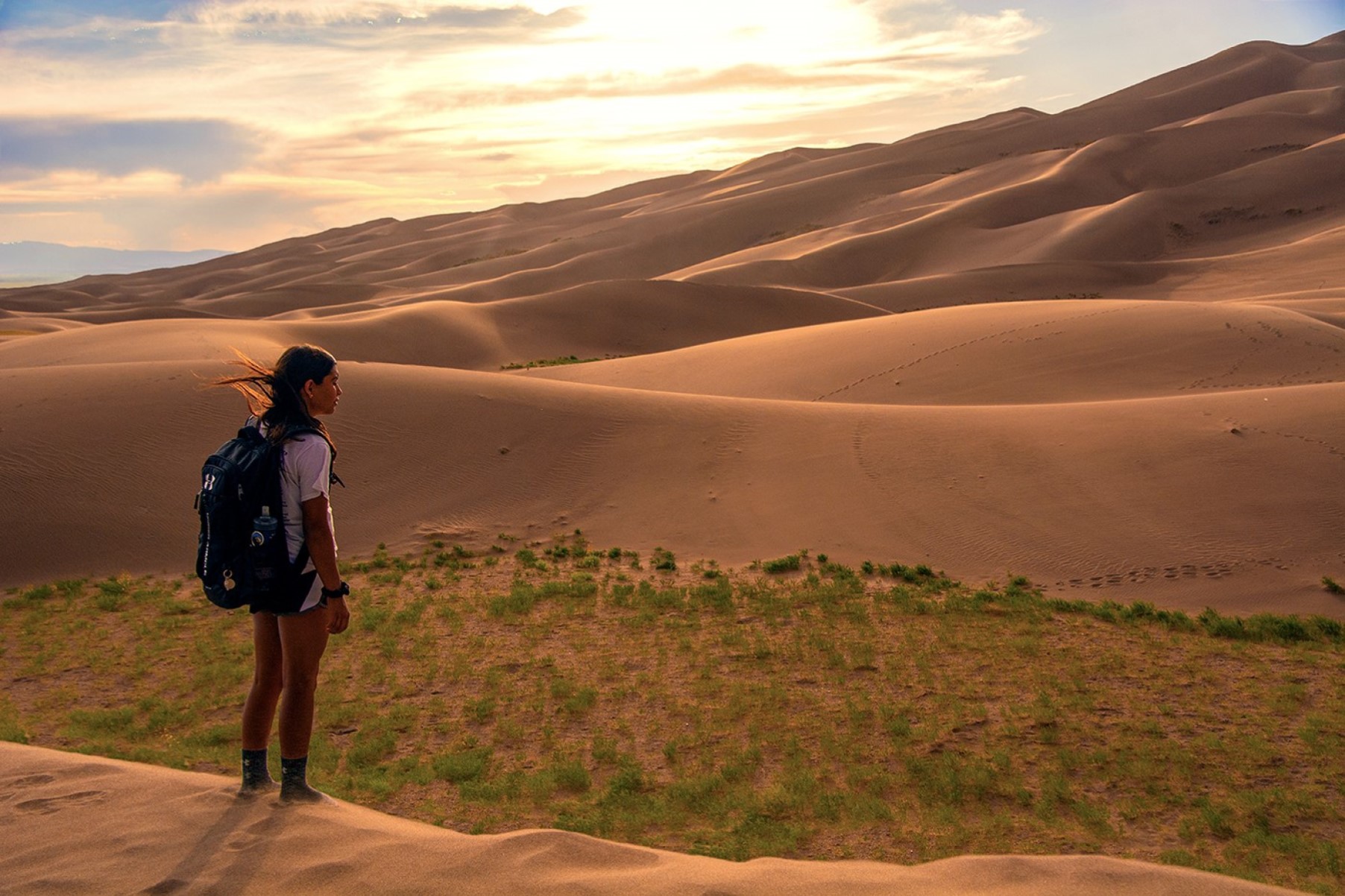
Explore the tallest dunes in North America! The centerpiece of Great Sand Dunes National Park and Preserve is the 30-square-mile (78-square-km) dunefield, featuring the tallest dunes in North America. Because there are no trails, you can venture out anywhere you'd like to discover unusual insects, plants, wildlife tracks, ripples, and sand grains of every color.
The centerpiece of Great Sand Dunes National Park and Preserve is the 30-square-mile (78-square-km) dunefield, featuring the tallest dunes in North America. Because there are no trails, you can venture out anywhere you'd like to discover unusual insects, plants, wildlife tracks, ripples, and sand grains of every color. In warmer months, watch for one of 7 species of endemic insects, found nowhere else in the world, that are specially adapted to the extreme environment here. During summer, plan your dunes time for early morning or evening to avoid sand surface temperatures of 150 degrees F, or thunderstorms with lightning and wind. Boots with long pants work best to keep sand out of your shoes. Walk on the tops of ridges for the firmest footing. It's very difficult for an adult to get lost in the dunes, because you can see the mountains, entrance road, and visitor center for reference. If you have time and energy, hike High Dune on First Ridge (692 feet/211 m), Star Dune (741 feet/226 m) or Hidden Dune (742 feet/226m). How were these dunes formed? Discover the answer in this Introduction to the geology of Great Sand Dunes. You can also discover geological processes at your feet! Look and feel for sinous ripples in the dunes. Lighter-colored, coarse sand made of sedimentary and metamorphic rocks from the nearby Sangre de Cristo Mountains forms ripples that slowly move over darker, fine-grained volcanic sand from the distant San Juan Mountains. You may also notice streaks or patches of black magnetite sand as you explore. This mineral is similar to iron, but never rusts. It gains its strong magnetic charge when lightning strikes magnetite mineral deposits in the Sangre de Cristo and San Juan Mountains. These deposits erode into sand that arrives in the dunes by wind and water, and the sand retains its magnetic charge. While this sand can be picked up with a magnet, please leave it here for others to also enjoy and study. Occasionally, visitors find rough tubes of dark glass on the sand formed from lightning. Learn about the formation of fulgurites in this short article. All natural and cultural objects in national parks are protected by federal law; you may pick them up and study them, but please leave them for other visitors to also enjoy. You may hear the dunes make sounds as you hike - listen to a recording and learn more about the 'singing sands'! More topics on Great Sand Dunes Introduction to Plants of Great Sand Dunes Introduction to Birds of Great Sand Dunes Introduction to Endemic Insects of Great Sand Dunes Introduction to Mammals of Great Sand Dunes Introduction to Amphibians of Great Sand Dunes Introduction to Reptiles of Great Sand Dunes Introduction to Fish of Great Sand Dunes
Tags
Front-Country HikingDunesUnique Speciesduneswildernessendemic insectstracksgeologyendemic species
Visitor Photos
No visitor photos yet
Details
Duration Details
Unlimited - you can explore for a few minutes or a few hours!
Fees
Regular entrance fees to the park include access to the dunes.
Fees Apply
No
Seasons
Winter, Spring, Summer, Fall
Time of Day
Day, Night, Dawn, Dusk
Accessibility
A limited number of sand wheelchairs are available for loan at the visitor center. One is designed for small adults, and one for small children. Although a helper is required to push the chairs through soft sand, large inflatable tires make short trips across the sand possible. Please keep these guidelines in mind when using sand wheelchairs: The adult chair is not suitable for large adults, or for an adult holding a child. The balloon tires can only support standard adult weight limits. Chairs should be borrowed only by those who need a chair for access. You'll need to leave an ID at the visitor center to ensure that the closet key is returned. Return the chairs at least 1/2 hour before the visitor center closes. Sand wheelchairs should only go on sand or smooth pavement, never on rocks or cactus which may pop the balloon tires. While the chairs are easy to push in the wet, firm sand along Medano Creek, pushing the chairs through dry, soft sand takes some strength and perseverance, even with balloon tires. During dry times of the year, the sand may become especially soft. Reserve a wheelchair in advance by calling the visitor center at 719-378-6395.
Pets
Yes — Pets are allowed anywhere in the main use area up to the top of the first high skyline ridge of dunes. Pets are not permitted beyond the first high dune ridge.
Reservations
No
Age Info
Any age can explore and play in the sand. Children should be supervised at all times to avoid getting lost. 1-2 year-olds may get sand in their mouths or eyes as they play with it. Young children are lower to the ground, and may experience heat exhaustion or burns from the hot sand surface if hiking in mid-day during summer months. Avoid the dunes during the hottest part of the day in summer. Instead, plan your dunes time for morning or evening, and spend the afternoon hours in forested areas or by water.
Location
First Ridge of Dunes