HIFU vs Thread Lift - Which One Is Right for You

Choosing between HIFU skin tightening and a face thread lift can be challenging. Learn how each treatment works, who may benefit most, and what results you can realistically expect before making a decision.
Choosing a facial rejuvenation treatment has become more complicated as non-surgical options continue to expand. Two treatments that are frequently compared are HIFU skin tightening and thread lifts. Both are designed to address skin laxity and signs of ageing, but they work in very different ways and are often suitable for different concerns.
People researching HIFU Skin Tightening and Face Thread Lift treatments are often looking for a straightforward answer about which option is better. The reality is that neither treatment is universally superior. The right choice depends on the degree of skin laxity, treatment goals, desired recovery time, and the type of result a patient hopes to achieve. Understanding these differences is often more helpful than simply comparing treatment popularity.
What Is HIFU Skin Tightening?
High-Intensity Focused Ultrasound (HIFU) is a non-surgical treatment that uses focused ultrasound energy to stimulate collagen production beneath the skin.
The treatment targets deeper structural layers without damaging the skin's surface. As collagen production increases, the skin gradually becomes firmer and tighter over the following months.
Many patients choose HIFU because it involves minimal downtime and produces gradual, natural-looking improvement rather than dramatic change.
What Is a Face Thread Lift?
A thread lift is a minimally invasive procedure that uses dissolvable threads placed beneath the skin to create a lifting effect.
Unlike HIFU, which relies entirely on collagen stimulation, thread lifts provide an immediate mechanical lift while also encouraging collagen production around the inserted threads. This combination allows patients to see some improvement immediately after treatment, with additional changes developing over time.
Thread lifts are commonly used to address mild to moderate skin laxity around the cheeks, jawline, neck, and lower face.
How Do the Treatments Work Differently?
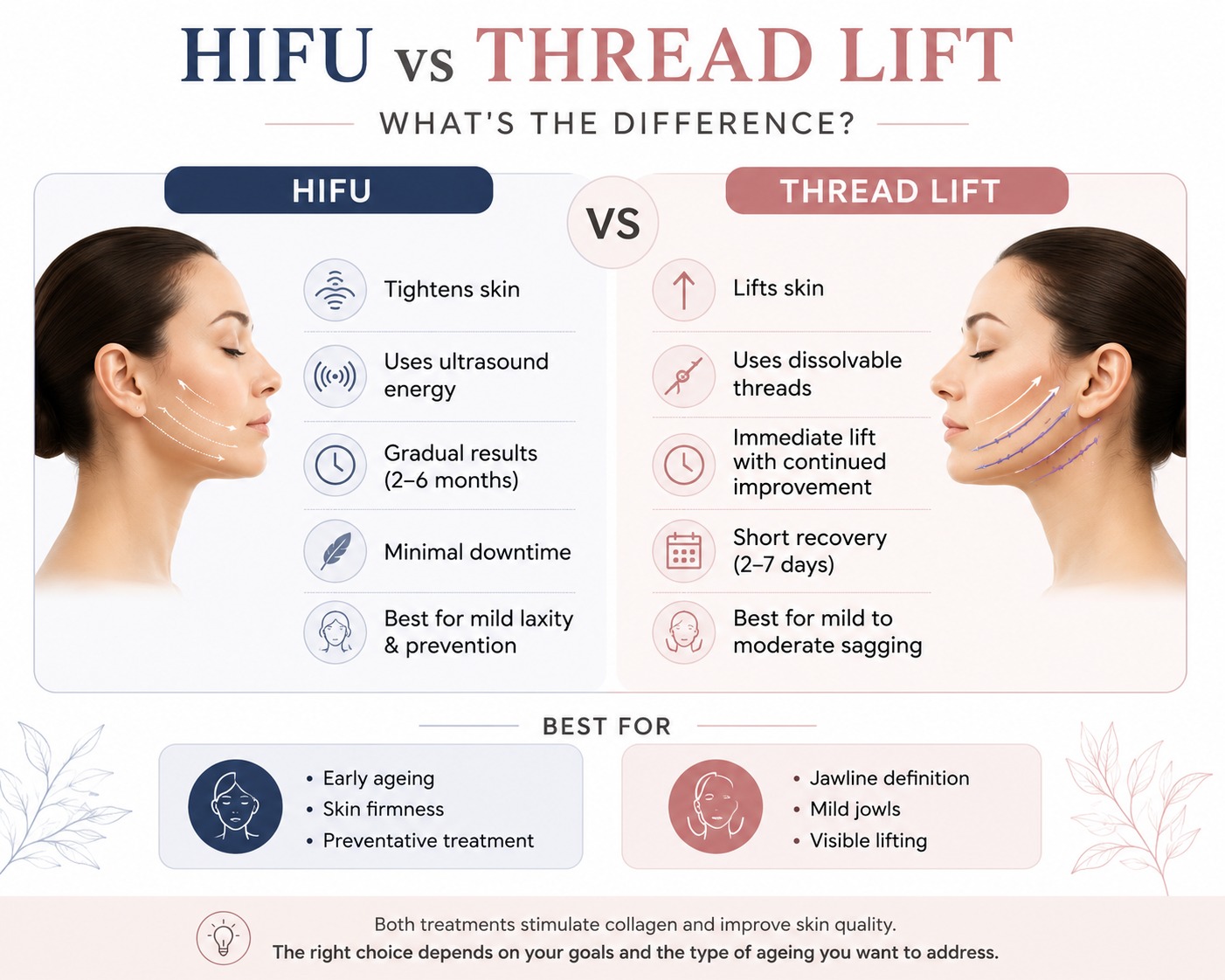
The most important difference lies in the mechanism of action.
HIFU works by stimulating the body's natural collagen production through controlled ultrasound energy. The treatment gradually improves skin firmness as new collagen develops.
Thread lifts physically reposition tissues using dissolvable threads while simultaneously stimulating collagen formation. This means thread lifts can provide a more noticeable lifting effect compared with collagen stimulation alone.
Although both treatments target ageing concerns, they achieve results through different processes.
Which Treatment Produces Faster Results?
Patients often ask which treatment delivers results more quickly.
Thread lifts generally produce visible improvement immediately because the threads physically lift the tissues during the procedure. Some swelling may temporarily affect the appearance, but patients often notice an early lifting effect.
HIFU works more slowly. While some people report subtle tightening shortly after treatment, the most noticeable improvements usually develop gradually over two to six months as collagen remodelling continues.
For patients seeking immediate improvement, thread lifts may be more appealing. Those comfortable waiting for gradual changes may prefer HIFU.
Who Is a Suitable Candidate for HIFU?
HIFU is often suitable for people experiencing:
Mild skin laxity
Early signs of ageing
Loss of skin firmness
Mild jawline softening
Early neck laxity
Patients who prefer non-invasive treatments with little downtime often consider HIFU before exploring more invasive procedures.
Many Melbourne residents choose HIFU as part of a long-term skin maintenance approach, particularly when ageing changes remain relatively mild.
Who Is a Suitable Candidate for a Thread Lift?
Thread lifts may be more appropriate for patients who have:
Mild to moderate skin sagging
Early jowl formation
Drooping cheeks
Mild loss of facial definition
A desire for more immediate lifting
Patients seeking a noticeable lift without surgery often consider thread lifts when collagen stimulation alone may not provide sufficient improvement.
What About Recovery Time?
Recovery is another important consideration.
Most HIFU patients return to normal activities immediately after treatment. Mild redness or tenderness may occur but generally resolves quickly.
Thread lifts involve a slightly longer recovery period. Bruising, swelling, tenderness, and temporary tightness are possible for several days after the procedure. Most patients resume routine activities relatively quickly, although some precautions are usually recommended during the healing period.
What Does the Research Say?
Research suggests that both treatments can improve mild to moderate signs of facial ageing when used appropriately.
Studies examining HIFU have reported improvements in skin laxity through collagen stimulation. Research involving thread lifts has demonstrated lifting effects and collagen production around dissolvable threads.
The evidence generally suggests that treatment success depends heavily on patient selection. Neither procedure is designed to replace surgical facelift procedures for individuals with significant skin laxity.
Which Treatment Lasts Longer?
Longevity varies between individuals.
HIFU results depend on ongoing collagen production and natural ageing processes. Many patients experience improvement for many months following treatment, although maintenance sessions may be recommended.
Thread lifts provide lifting through the threads themselves while also encouraging collagen development. As the threads dissolve, collagen support remains, but future ageing continues naturally.
Rather than focusing only on duration, patients often benefit from considering which treatment is most appropriate for their current concerns.
Can HIFU and Thread Lifts Be Combined?
In some cases, practitioners may recommend combining treatments.
Because HIFU and thread lifts work differently, they can sometimes complement one another. HIFU focuses on collagen stimulation and skin tightening, while thread lifts provide structural lifting.
Treatment recommendations should always be based on individual assessment rather than assumptions about which procedure is considered better.
Final Thoughts
The question is not whether HIFU or thread lifts are better. The more useful question is which treatment aligns with a patient's specific concerns and goals.
HIFU may be well suited to individuals seeking gradual skin tightening through collagen stimulation with minimal downtime. Thread lifts may appeal to those looking for a more immediate lifting effect without surgery.
Clinics such as Dr. Green Cosmetic Group in Melbourne often find that treatment suitability depends less on age and more on factors such as skin quality, facial anatomy, and realistic expectations. Understanding what each treatment can achieve remains one of the most important steps before making a decision.
Frequently Asked Questions
Is HIFU better than a thread lift?
Neither treatment is universally better. HIFU is often preferred for mild skin laxity and collagen stimulation, while thread lifts may be more suitable for patients seeking a stronger lifting effect.
Do thread lifts last longer than HIFU?
Both treatments provide temporary improvements, but longevity varies depending on the individual, treatment area, and natural ageing processes.
Can HIFU replace a thread lift?
HIFU may improve skin firmness, but it does not provide the same physical lifting effect as a thread lift.
Which treatment has less downtime?
HIFU generally involves less downtime because it is completely non-invasive, while thread lifts may involve temporary swelling and bruising.